An Enormous Challenge
Note: This is my second attempt at this post. The situation here is very different from Western countries. It is unfair — even impossible — to make comparisons.
It is a volatile electrical landscape, given the number of typhoons, lack of government funding, degraded / semi-repaired existing electrical infrastructure, a four-silo business structure (explained below), widespread poverty, and third-world design, management, and construction.
I have a friendly, working relationship with the managers of our local electrical substation. Over the years, I have sent them very accurate information on outages we observe in two different barangays, even identifying damaged components, pole numbers, and voltage readings. A few times, the NEECO manager or crew chief has called me for details. Where else in the world would you have the cell phone number of the local substation manager?
It is a blessing to have a collegial relationship given our electrical landscape.
This is a tropical coun
Every few days there is a power outage. Not necessarily at our exact location, but somewhere in the co-op’s service area. About ten to twenty times per month there is a power outage. Often lengthy ones.
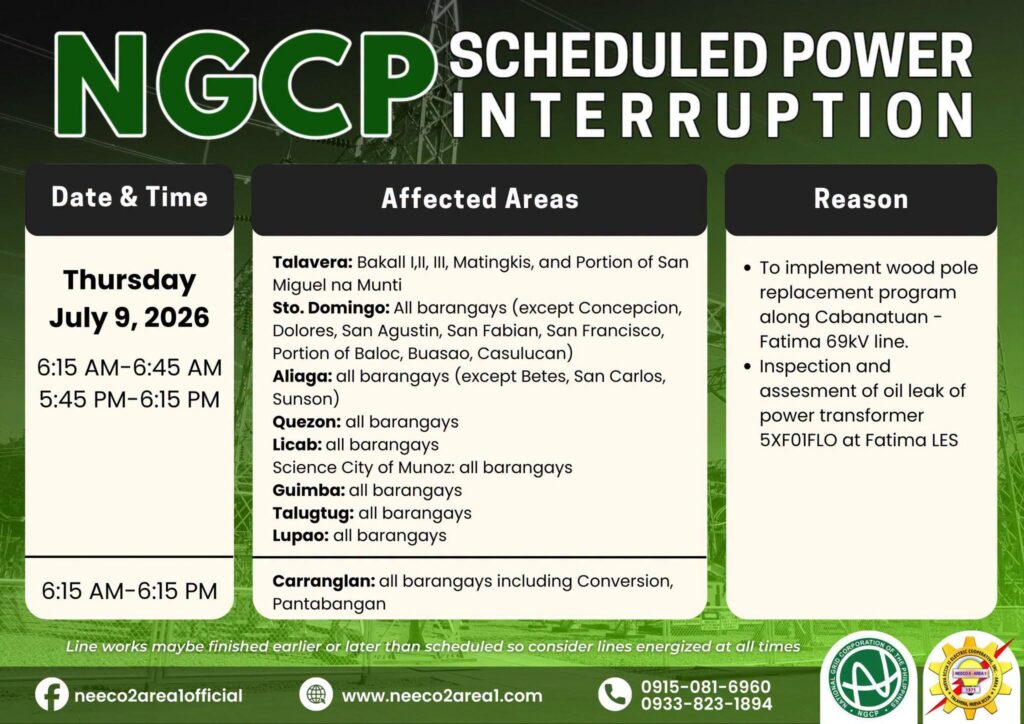
Not that it’s called “a power outage.” It called a “brownout” or a “power interruption” and treated as fairly routine.
About half of these outages are PLANNED. No kidding. Scheduled one or two weeks ahead. Some of them last all day. The powers that be just turn off the whole city or half the state or your neighborhood whenever it suits them. “Replacing rotten poles.” “Removing overgrowth.” “Switching to a different circuit.” Whatever it might be for however long it takes.
[Above] No power in Carranglan for the entire day. This is not unusual. Not exceptional. There is no redundancy built into the system. No way to reroute fallen lines. No extra power capacity.
NGCP is the National Grid Corporation of the Philippines. Oddly, 40% of this ‘national’ grid operator is owned by China. China knows every nut and bolt of the largest electrical grid in the Philippines. That seems like a great vulnerability to me.
And NEECO is the local co-op, responsible for the collection of money, issuing monthly bills, and maintaining the local substations, switches, wires, and poles. But they DO NOT GENERATE any electrical power.
The co-op catches it from all directions. Since NEECO (Nueva Ecija Electric Cooperative) doesn’t generate any power they are at the mercy of NGCP. If NGCP pulls the plug (and they do), off go the lights of NEECO subscribers.
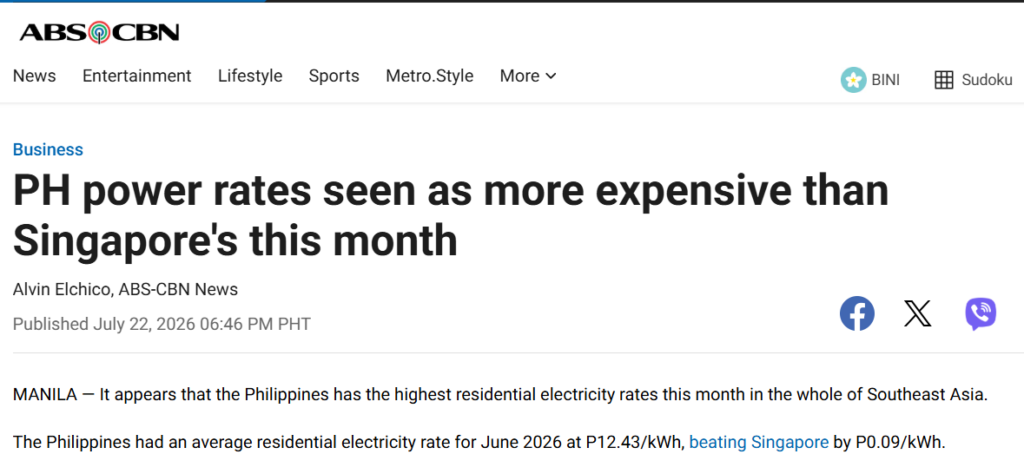
And if the government raises a tax or introduces a new fee (and they do), NEECO bears the ire of every howling subscriber — and they did nothing wrong!
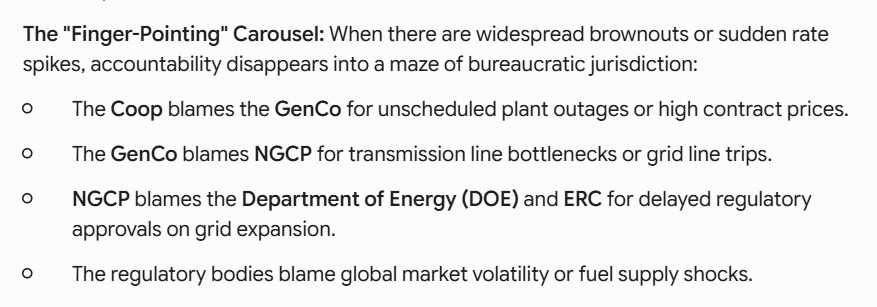
Around 2000, the Philippine government privatized the formerly state-run electrical system. Sadly, they broke it into four pieces. Instead of “an electricity company” you have a handful of companies, each with a different profit motive. Each of these silos adds costs which are eventually shouldered by the end consumer.
There are power generating companies. Power suppliers (brokers, sellers of bulk electricity). Distribution companies like my co-op. And transmission companies like NGCP. Each needs to make a profit. Each points the finger elsewhere when things go wrong.
Still, on most days we have power. And when we don’t, we run the little generator. It takes care of all the lights, fans, water pumps, and lets us run (not at the same time) the hot water kettle, aircon, rice cooker, washing machine, etc.
Speaking of generation —
Chronic Generation Deficiencies
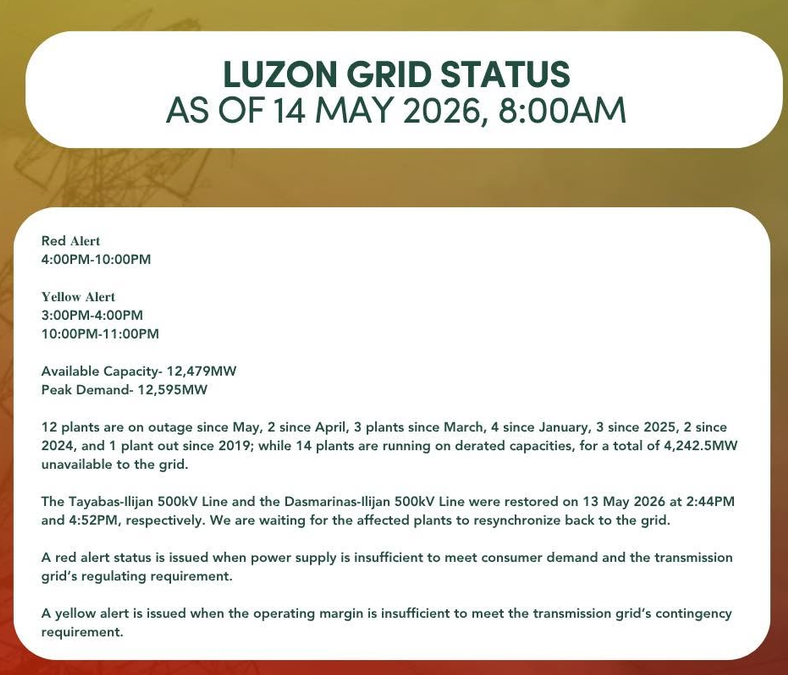
There is not enough fault-tolerance built into the system.
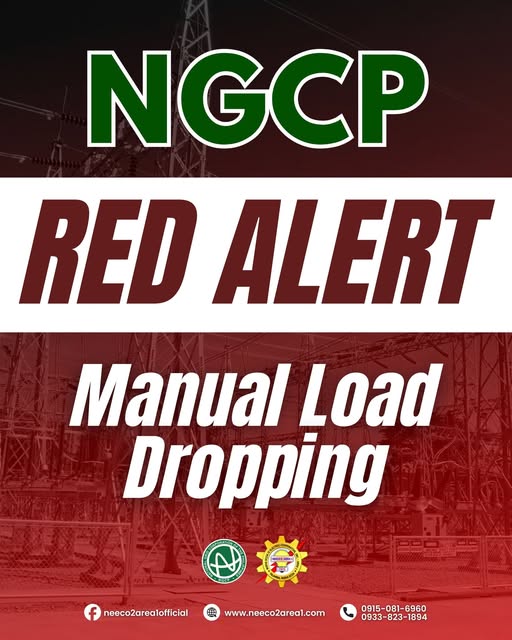
Manual Load Dropping means, “We are going to turn you off because we can’t meet the demand.”
Leave a Reply